Market Intelligence
RSS Feeds vs. Social Monitoring: Which Works Better?
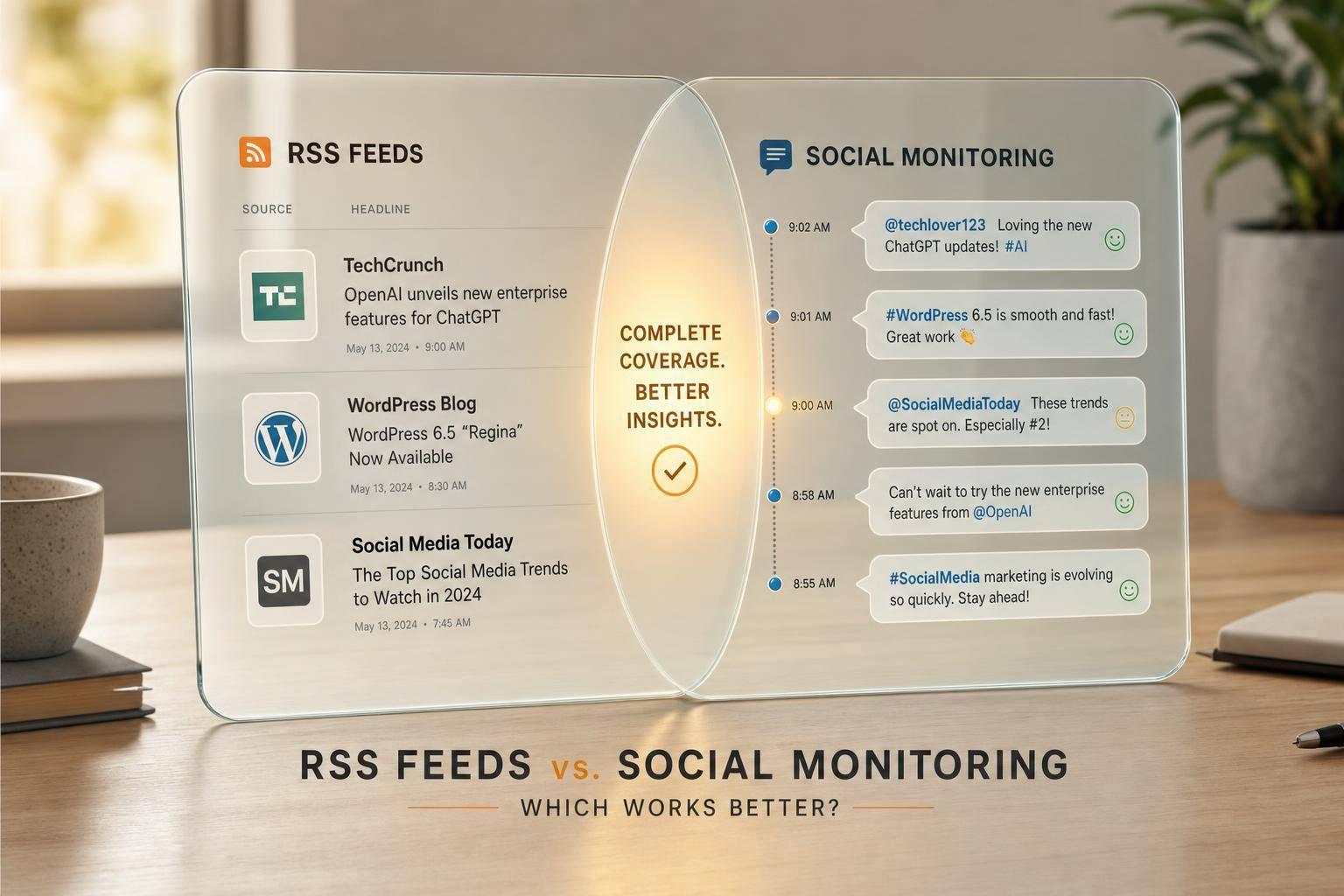
RSS Feeds vs. Social Monitoring: Which Works Better?
If I need a short answer, it’s this: RSS is better for clean updates from sources I pick, while social monitoring is better for live public chatter. In most cases, I’d use RSS for official news, research, and company updates, and social monitoring for mentions, sentiment, and issue spotting. Used together, they cut blind spots and help me check what matters faster.
Here’s the article in plain terms:
- RSS feeds pull updates from known sites like newsrooms, blogs, and research pages.
- Social monitoring tracks public posts on places like X, Reddit, and LinkedIn.
- RSS has less noise because the source list is fixed.
- Social monitoring moves faster because people post before formal write-ups appear.
- RSS is better for records and source-based tracking.
- Social monitoring is better for reaction, complaints, and buzz.
- If I use only one, I can miss either the official update or the public response.
A simple rule works well:
- Use RSS when I want accuracy, order, and lower clutter.
- Use social monitoring when I want early signs, brand mentions, and public feedback.
- Use both when I need the full picture.
In practice, this split matters a lot. For example, a competitor may post one product update in its newsroom, but that same update can lead to dozens or even hundreds of public reactions across social platforms. One tool shows the source. The other shows the response.
Quick Comparison
| Criteria | RSS Feeds | Social Monitoring |
|---|---|---|
| Main source | Selected publishers | Public platforms |
| Best use | News, research, official updates | Mentions, sentiment, chatter |
| Speed | Depends on when a source publishes | Near real-time |
| Noise level | Lower | Higher |
| Fact-checking | Easier | Harder |
| Public reaction | Limited | Strong |
| Record-keeping | Strong | Weaker |
My takeaway: RSS gives me the paper trail. Social monitoring gives me the first hint that something is moving. If I care about both truth and timing, I’d use both.
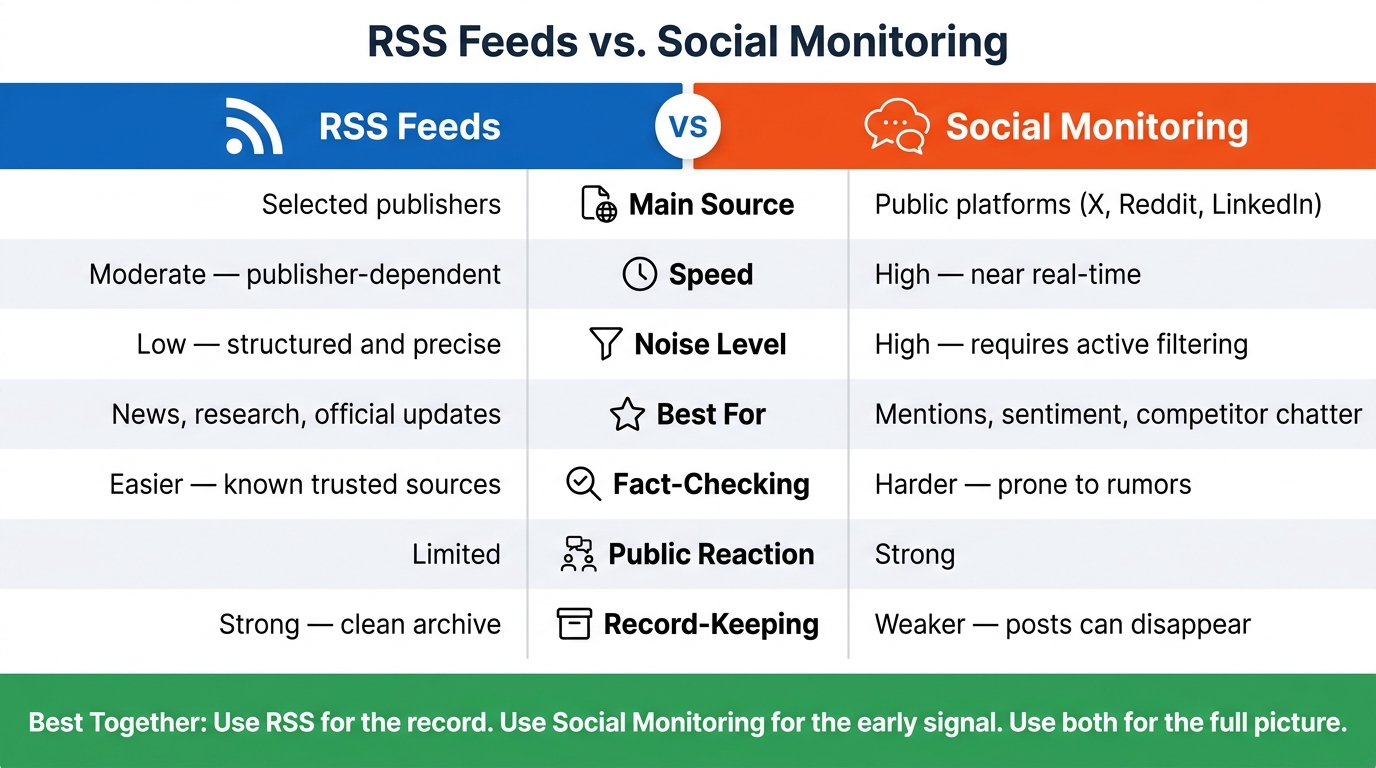
RSS Feeds vs. Social Monitoring: Side-by-Side Comparison
The Ultimate Beginner's Guide to RSS (use THIS instead of Social Media)
sbb-itb-15d6cfa
How RSS Feeds and Social Monitoring Differ
The difference comes down to control, speed, and noise. Put simply, RSS follows a hand-picked source list, while social monitoring checks open public streams.
RSS Feeds: Structured Updates from Known Sources
RSS pulls content straight from sources you choose, such as newsrooms, industry blogs, research outputs, and official company publications. You build the list. When one of those sources publishes something new, it appears in your feed in chronological order, with no ranked filtering in the middle.
So if a policy update or research report goes live, you see it. That makes RSS a strong fit for official updates and for topics where accuracy and stability matter.
The downside is simple: RSS only shows what publishers decide to publish. It won’t show how people react to that update. You get the source, not the conversation around it.
Social Monitoring: Live Public Conversations and Mentions
Social monitoring takes a different path. Instead of pulling from a selected list of publishers, it scans public platforms like X/Twitter, Reddit, and LinkedIn for keywords, brand names, or topics you want to track.
Because the signal is live, it helps you spot brand mentions, competitor chatter, and new topics fast.
The catch is volume. Public platforms create a lot of chatter, and plenty of it won’t matter to you. Cutting out irrelevant mentions takes work, and heavy volume can muddy the signal. Reddit threads and X/Twitter replies can surface reactions fast, but they can also pile on clutter.
| RSS Feeds | Social Monitoring | |
|---|---|---|
| Source type | Selected publishers | Public platforms (X, Reddit, LinkedIn) |
| Speed | Moderate - publisher-dependent | High - live signals |
| Noise level | Low - structured and precise | High - requires active filtering |
| Best for | Industry news, research, official updates | Brand mentions, sentiment, competitor chatter |
Those differences show up most clearly when you’re handling specific tracking tasks.
RSS Feeds vs. Social Monitoring by Use Case
The right pick comes down to the kind of signal you want. Different jobs call for different tools.
Tracking News, Industry Topics, and Research
RSS works better for official updates and research. If you subscribe to trade publications, regulatory feeds, and official newsrooms, new content comes straight from the source.
Social monitoring adds the reaction layer. It shows what people are saying on LinkedIn, which Reddit threads are picking up steam, and how a story spreads after it goes live. It can also show when bad information gets attached to that story.
RSS gives you the source. Social monitoring shows what happens next.
Monitoring Competitors, Brand Mentions, and Reputation
The gap is just as clear when you're watching competitors or tracking brand reputation. If you subscribe to a competitor's blog, press release feed, or official newsroom, you'll see when they publish a product update, whitepaper, or official announcement.
Social monitoring catches the public chatter that RSS misses. A customer complaint on Reddit, or a LinkedIn post that starts getting shared for criticizing a brand, won't show up in an RSS feed. Keyword and mention tracking across open platforms brings that conversation to the surface as it happens.
| Signal Type | RSS Feeds | Social Monitoring |
|---|---|---|
| Product launches | Strong - catches official blog and press announcements | Moderate - surfaces reactions and commentary |
| Public mentions | Weak - only if the source publishes about you | Strong - catches direct name mentions across platforms |
| Customer feedback | Weak - rarely published in structured feeds | Strong - Reddit, X/Twitter, and LinkedIn surface raw sentiment |
| Earned media coverage | Moderate - picks up newsroom coverage | Strong - catches shares, threads, and secondary discussion |
Following Fast-Moving Conversations and Potential Issues
When something starts moving fast, social monitoring usually gets there first. Mentions often spike on X/Twitter before any official statement appears.
RSS becomes more useful after that first burst. Once official statements and deeper reporting are published, RSS picks up that layer in a clean way. A simple way to think about it: social monitoring is the early warning system, while RSS is the record you can point back to later.
| Feature | Social Monitoring | RSS Feeds |
|---|---|---|
| Immediacy | High - captures live mentions and viral spikes | Lower - depends on source publication frequency |
| Verification | Lower - prone to rumors and misinformation | High - comes directly from known, trusted sources |
| False positives | High - bots and noise require filtering | Low - pre-selected sources keep it clean |
| Documentation | Useful for capturing real-time sentiment data | Best for official records, filings, and formal reports |
When to Use RSS, When to Use Social Monitoring, and When to Use Both
Choose RSS for Precision, Stability, and Lower Noise
RSS makes the most sense when you want a steady signal from sources you already trust, like competitor newsrooms, policy feeds, and research institutions. If the job is to track a policy area or a slow-moving industry story over weeks or months, RSS is usually the cleaner option. It gives you an archive you can go back to later, which matters more than people think. Social feeds move fast, and key posts can disappear under the pile.
In Feedly, it helps to sort subscriptions into folders by topic or competitor. In Inoreader, rules can auto-tag or filter content by keyword, so the items that matter most rise to the top instead of getting buried.
If you also need to see how people are reacting in public, RSS alone won't cover that part.
Choose Social Monitoring for Speed, Mentions, and Conversation Signals
Social monitoring is the better fit when speed matters and the signal is coming from public conversation rather than official publishing. A customer complaint picking up steam on Reddit, or a public thread criticizing a brand decision, may never show up in an RSS feed. That's where social monitoring earns its keep. It's also the right pick for brand mentions and reputation tracking, since it shows what people are saying about your company, your product, or your competitors across open platforms.
The catch is noise. Cast too wide a net with keywords, and you'll pull in a mess of irrelevant posts. Go too narrow, and you'll miss the mentions that matter. Good relevance scoring helps trim the clutter and make the stream usable.
When you need speed and a way to verify what you're seeing, using both tools starts to make a lot of sense.
Combine Both for Better Coverage and Faster Detection
The strongest setup uses social monitoring as the early warning layer and RSS as the validation and archive layer. Social flags the first spike. RSS backs it up with sourced, official reporting.
A simple workflow works well here:
- Check overnight RSS updates from your key sources first
- Then review social monitoring for mention spikes or new conversations that need follow-up
That leads straight to the final choice: RSS, social monitoring, or both.
Conclusion: Which Works Better Depends on What You Need to Track
The final call comes down to one thing: what kind of signal you need for your workflow.
RSS works better when you want structured, low-noise updates. Social monitoring works better when you want real-time public reaction.
Choose based on:
- source type
- speed
- noise tolerance
- whether you need official updates, public reaction, or both
For most teams, this isn't an either/or call. Use both when you need official updates and live conversation signals. RSS gives you the record; social monitoring gives you the early signal.
The best choice is the one that fits the signal you're trying to track.
FAQs
How do I choose between RSS and social monitoring?
Choose based on your goal.
Use RSS when you want a steady, time-based feed from specific sources. It works well for industry news, long-form articles, and topic tracking without all the platform noise.
Use social monitoring when you need real-time conversations, brand mentions, sentiment, and trending topics across places like X, Reddit, and LinkedIn.
If you want the best coverage, use both.
Can RSS replace social monitoring for brand tracking?
No. RSS works well for tracking structured updates from websites and industry news sources. But it doesn't give you the real-time, interactive view you need to follow fast-moving conversations, brand mentions, and public sentiment across social platforms.
A better approach is to split the job:
- Use RSS for industry news and competitor research
- Use social monitoring for immediate brand engagement and reputation management
That way, you get both the steady flow of published updates and the live pulse of what people are saying right now.
What’s the best way to use both together?
Use RSS feeds for reliable, controlled sources like industry news sites, competitor blogs, and journals. Then pair that with social monitoring on X, Reddit, and LinkedIn to spot real-time conversations, sentiment, and brand mentions.
Put together, they give you a stronger read on what’s happening. RSS gives you a steady baseline. Social monitoring adds speed and context. That way, you can compare fast-moving trends with verified news and get better coverage and relevance.