Readability Checker
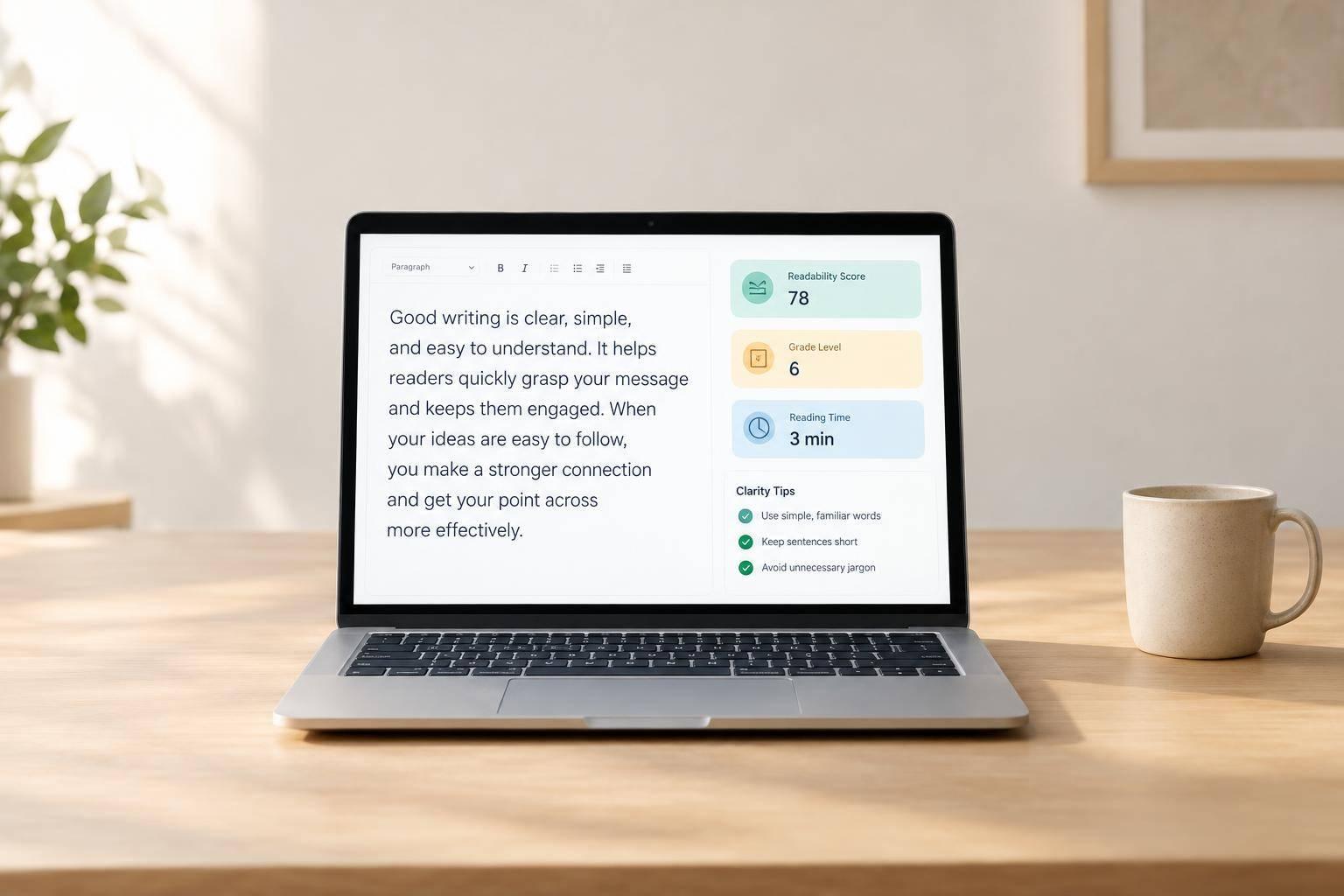
Readability Checker
Understand How Easy Your Writing Is to Read
A strong readability checker does more than assign a number to your text. It helps you understand whether your writing feels smooth, clear, and approachable for the audience you want to reach. If a paragraph is packed with long sentences, complex words, or indirect phrasing, readers may lose track of the message even when the ideas are solid.
What This Tool Measures
This tool analyzes sentence length, word count, paragraph structure, syllables, and estimated complexity to generate widely used readability metrics. You’ll see scores such as Flesch Reading Ease, Flesch-Kincaid Grade Level, Gunning Fog, SMOG, and Automated Readability Index, along with reading time and a practical summary of what the numbers suggest.
Why Readability Matters
A reliable readability checker is useful for blog posts, academic drafts, business writing, web content, and email copy. Clear writing usually performs better because it asks less of the reader. When text becomes too dense, even valuable information can feel harder to absorb.
Write With More Clarity
Use this text readability tool to spot long sentences, possible passive voice, and overly complex wording. Small edits can make your message easier to follow without oversimplifying what you want to say.
FAQs
What does a readability score actually tell me?
A readability score estimates how easy or difficult a piece of writing may be for someone to read. Different formulas look at things like sentence length, word length, syllables, and complex vocabulary. That means the score isn’t judging whether your ideas are good—it’s measuring how much effort a reader may need to process the text. It’s best used as a practical guide for revising clarity, not as a strict rule.
Why are there several readability formulas instead of just one?
Each formula measures readability a little differently. Flesch Reading Ease focuses heavily on sentence and word complexity, while Flesch-Kincaid translates that into an estimated U.S. grade level. Gunning Fog, SMOG, and ARI each weigh factors like complex words, characters, or sentence structure in their own way. Looking at several scores together gives you a more balanced view than relying on a single number.
Can this tool detect passive voice and unclear writing perfectly?
Not perfectly, and that’s true for any heuristic-based checker. Passive voice detection and writing-quality signals are pattern-based estimates, so they’re useful for finding likely trouble spots rather than making absolute grammatical judgments. The real value is that the tool helps you notice sections worth reviewing—especially long sentences, dense wording, and phrasing that may slow readers down.