Market Intelligence
Exact Match vs Semantic Matching: Which One to Use for Which Watch

Exact Match vs Semantic Matching: Which One to Use for Which Watch
Most watch setups fail in one of two ways: they miss live mentions, or they swamp the team with junk. The fix is usually simple.
- Use exact match for fixed labels: brand names, executive names, SKUs, stock tickers, URLs, and error codes.
- Use semantic matching for messy language: complaints, buying intent, crisis wording, and early topic shifts.
- Use hybrid when a miss is expensive: competitor tracking, reputation risk, and pricing-page changes.
A plain exact watch can stay clean and still miss posts that say the same thing in different words. A plain semantic watch can find those posts and still drift into off-topic chatter. The right choice depends less on the tool and more on the monitoring solutions required for the signal.
This is not a theory problem. On live feeds, even a 5% to 10% false-positive rate can make alerts hard to trust, and missing one real complaint on Reddit or X can cost more than reviewing a few extra matches. The job is to set the watch so it catches what matters with the least review load.
| Watch type | Best fit |
|---|---|
| Executive names, tickers, SKUs, URLs | Exact match |
| Complaints, crisis language, early topic shifts | Semantic matching |
| Competitor intent, pricing changes, reputation risk | Hybrid |
The rule is simple: anchor on what is fixed, expand only where wording shifts.
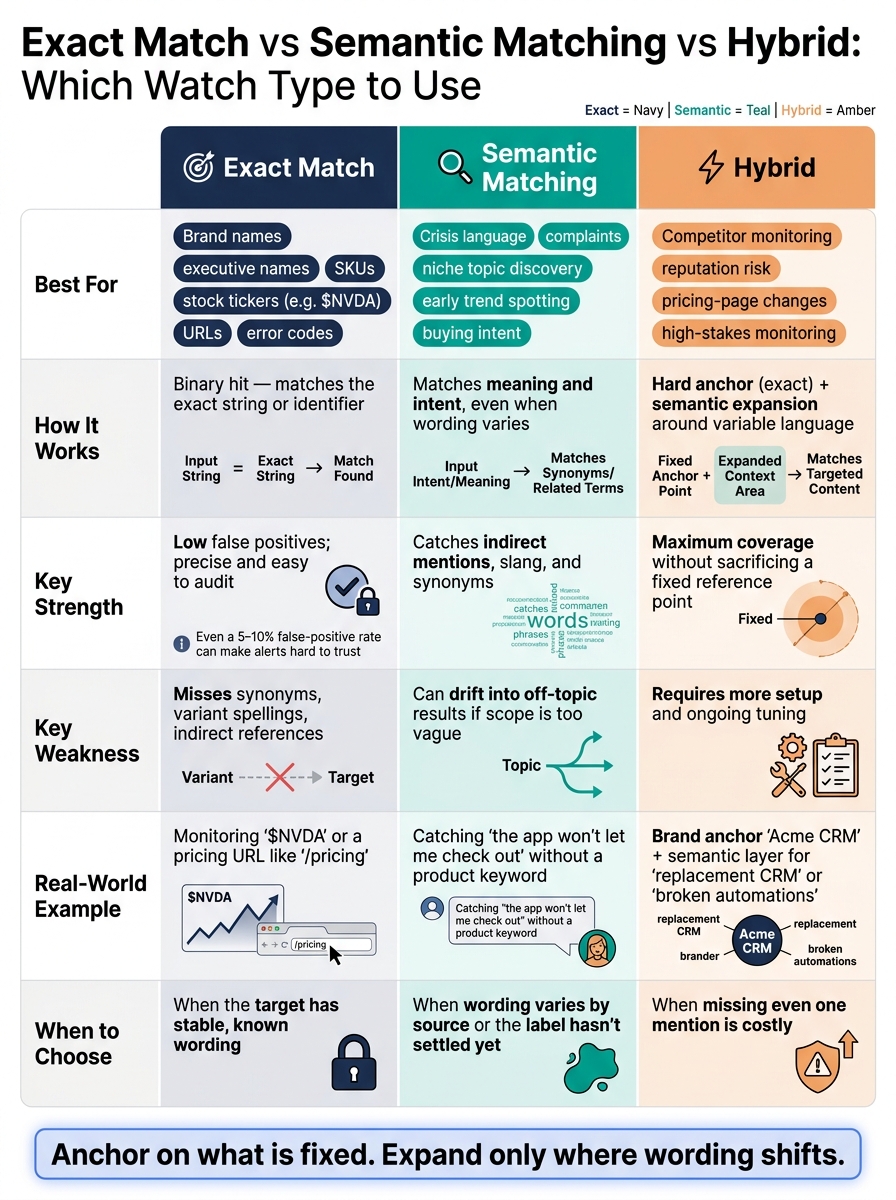
Exact Match vs Semantic Matching vs Hybrid: Which Watch Type to Use
Lexical Search vs Semantic Search. What's the difference?
sbb-itb-15d6cfa
Match the method to the watch, not the other way around
You get better monitoring when the method fits the thing you’re watching. The useful question isn’t “which method wins?” It’s “what kind of signal shows up here, and how do you catch it without dragging in junk?”
Some signals are fixed labels. Others show up as messy human language. Treat those the same way, and the watch either misses too much or floods you with noise.
Use exact match for executive names, official brand names, and page-specific checks
Exact match works when the target is literal and stable. CEO names, official brand names, stock tickers like $NVDA, SKUs, and fixed URLs all fit that pattern. In those cases, the match is binary: it either hits the right identifier or it doesn’t.
That matters because these terms usually have a tight meaning. If the watch is for a person like Jensen Huang, a product code, or a pricing page URL, you don’t want “kind of related.” You want the exact string. False positives stay low because the identifier does most of the filtering for you.
Page-specific checks are a good case. If you monitor a pricing page, exact match should track the plan names and the price points themselves. If “Pro” moves from $49/month to $59/month, or a URL changes from /pricing to /plans, exact match sees the change cleanly.
That said, pricing pages often change in ways that literal checks miss. A tier can stay at the same dollar amount while the copy shifts from “unlimited users” to “up to 5 users,” which is still a major change. That’s where a hybrid watch makes more sense: exact match for plan names and prices, semantic matching for copy that points to a real tier change.
Exact match handles fixed identifiers better than broad topic watches because the target is narrow enough that precision matters more than interpretation.
Use semantic matching for crisis language, niche topic discovery, and early trend spotting
People don’t speak in clean keyword lists. They describe a problem the way it feels in the moment, often with missing details, slang, or half-formed complaints. That’s why crisis monitoring breaks when it depends only on literal terms.
A post that says “the app won’t let me check out” may never mention your product category, support tag, or chosen keyword set. Still, it’s a real signal. Semantic matching catches the meaning of the complaint even when the wording doesn’t line up with the watch terms.
The same problem shows up with early trends. New categories usually arrive before the label settles. People talk about what a thing does before they agree on what to call it. If the market hasn’t settled on the name yet, exact match has almost nothing to grab.
Niche topic discovery works the same way. Industry language and user language often live on different planets. A watch for “enterprise resource planning” sounds tidy in a board deck, but the person who needs that software is more likely to post about “too many spreadsheets,” “inventory is a mess,” or “orders keep falling through the cracks.” Exact match misses that gap. Semantic matching doesn’t need the right label if the problem statement is close enough.
Once the watch shifts from labels to problems, semantic matching starts carrying the load. That doesn’t mean it’s magic. It can still pull in near-matches that share the tone but not the actual issue, especially in noisy channels like X or Reddit. You get more reach, but you also take on more review work.
Run a hybrid watch when missing a single mention is costly
Some watches can’t afford to choose between precision and coverage. In those cases, the safer setup is hybrid: lock onto the literal term, then expand around the problem language that usually travels with it.
Competitor monitoring is the cleanest example. Exact match should watch the competitor’s official brand name. Semantic matching should look for intent and pain around that brand, such as requests for alternatives, migration questions, or complaints about weak spots. That gives you direct mentions plus the surrounding demand signal.
A plain exact-match watch on a competitor catches “Acme CRM,” but it may miss posts like “what’s a good replacement for the CRM that keeps breaking automations?” if the person never says the brand name. A plain semantic watch does the opposite: it may find dissatisfaction and switching intent, but not tie it cleanly to the competitor you care about. Hybrid closes that gap.
Reputation-sensitive monitoring follows the same pattern. During a recall, legal issue, or safety scare, the company name matters, but so does the language around harm and escalation. Newsrooms, customers, and analysts rarely stick to one phrasing. One source may use the company name and “recall,” another may use “investigation,” and a customer may post “this feels unsafe” with no formal term at all.
In that kind of cycle, exact match should pin the company name, product name, or model number. Semantic matching should widen around terms like “recall,” “lawsuit,” “investigation,” and “safety concern.” That setup catches both the direct reference and the drift in public wording as the story moves.
There’s a trade-off here. Hybrid watches take more setup and more tuning than a single-method watch. If the semantic side is too loose, the feed gets noisy. If the exact side is too narrow, you miss side-channel discussion. The cost of that tuning is worth it only when the downside of missing one mention is high.
The working rule set is simple:
- Exact match = fixed labels
- Semantic matching = problem language
- Hybrid = fixed anchor + semantic expansion
| Watch type | Method |
|---|---|
| Executive names, ticker symbols, SKUs | Exact match |
| Pricing-page changes | Hybrid |
| Crisis signals, complaints | Semantic |
| Niche topic discovery, early trends | Semantic |
| Competitor mentions + intent signals | Hybrid |
| Reputation-sensitive monitoring | Hybrid |
In practice, this keeps the watch aligned with the signal. Fixed identifiers need strict matching. Messy human complaints need meaning-based matching. High-stakes monitoring usually needs both. KAEOA applies the same logic when teams need coverage without turning the watch into a cleanup job.
Build 3 watches step by step to improve relevance without extra busywork
Set up a competitor watch with exact brand anchors and semantic discovery
Most teams start monitoring too wide, then drown in junk. The fix is simple: lock the watch to the competitor brand first, then add semantic coverage for the pain points that brand is tied to.
Use exact brand anchors as the base query. A pattern like "Acme Cloud" OR "AcmeCloud" -jobs -careers keeps the stream cleaner than a loose keyword watch. Run that query across news sources, Reddit, Hacker News, and RSS feeds so you catch both press coverage and the rougher, more honest discussions that happen in forums.
That exact layer gives you direct mentions. It does not catch the buyer who complains about a problem the competitor solves without naming the vendor. That’s where semantic matching helps. Add problem language such as higher cloud costs, pay-as-you-go pricing, and billing for shared accounts so the watch picks up posts like, “our cloud bill jumped again” or “we need usage pricing that doesn’t punish shared teams,” even when Acme Cloud never appears.
Think of it like search plus interpretation. Exact matching answers, “Did someone name the company?” Semantic matching answers, “Did someone describe the same pain in plain English?” You need both if the goal is relevance rather than volume.
A clean setup often looks like this in practice:
- Exact anchor:
"Acme Cloud" OR "AcmeCloud" -jobs -careers - Semantic layer: higher cloud costs, pay-as-you-go pricing, billing for shared accounts
- Sources: news, Reddit, Hacker News, RSS feeds from trade publications and vendor blogs
That hybrid pattern also works for executive and crisis tracking, but those watches need tighter rules. If you go too broad too early, you end up tracking gossip, old bios, and junk reposts instead of signals that matter.
Set up an executive and crisis watch with strict filters first
Executive monitoring falls apart when the query starts with title words instead of the person. Names need to anchor the watch. Start with the executive’s full name plus the company name, and only add title variants if the title changes what the watch is supposed to find.
For example, a watch anchored on a person and company is usually cleaner than a watch anchored on role terms like CEO or Chief Revenue Officer. Titles drift. People change jobs. News writers shorten titles, skip them, or use older ones. Exact matching on the full name cuts a lot of that noise.
After the exact layer settles down, add semantic matching for crisis language. Terms like leadership change, investigation, data exposure, and financial irregularities catch the same event described from different angles. One outlet might say “board review,” another might say “internal probe,” and a forum post might say “something’s off in finance.” A semantic pass helps group those as the same kind of issue without forcing you to guess every phrase upfront.
A strict executive watch usually follows this order:
- Full name + company name
- Add title variants only if needed
- Add semantic crisis terms after the exact layer proves clean
That order matters. If you start with broad crisis terms, the watch starts pulling in every executive scandal on the internet. If you start with the person and company, then layer in crisis language, the stream stays focused on the right subject.
There’s a trade-off, though. Strict filters can miss edge cases, especially when a source uses only a last name, a misspelling, or a vague reference like “the company’s top finance leader.” If the watch is too narrow, you’ll miss some soft signals. If it’s too loose, your team stops trusting it. That’s the balancing act.
Exact match reduces noise; semantic matching catches indirect mentions.
That line holds up in practice, but only if the exact side stays in charge. Semantic matching should widen coverage, not run the show.
For page-change monitoring, the anchor changes again. Now the key object is not a person or a brand mention. It’s the page itself, plus the commercial terms on that page that tell you whether something meaningful changed.
Set up a pricing-page change watch with page diffs and exact terms
Pricing pages change all the time, and most of those edits are not worth a Slack alert. Font tweaks, headline refreshes, and layout shifts happen constantly. If the watch treats every diff like a major event, people tune it out in a week.
Anchor this watch to the actual /pricing or /plans URL. That gives you direct page-change monitoring instead of waiting for someone to mention the update somewhere else. Then pair that page watch with exact terms that point to revenue logic: enterprise, annual billing, free trial, per user, and monthly.
Use exact matching for plan names and prices too. If a vendor changes Pro from $49/month to $59/month, or adds a new Enterprise tier, exact terms make that easy to flag. Semantic matching belongs on the copy that hints at a product or packaging change, not on every line of the page. For instance, a phrase shift from “contact sales” to “starts at $999/month” may signal a pricing move. A rewrite from “built for growing teams” to “made for modern teams” usually does not.
The point is to separate cosmetic edits from business changes. A hybrid watch helps with that because page diffs show that something changed, while exact and semantic filters help decide whether the change matters.
A practical setup looks like this:
| Watch target | Exact terms | Semantic use |
|---|---|---|
/pricing or /plans URL |
plan names, prices, enterprise, annual billing, free trial, per user, monthly | detect wording that points to a tier, packaging, or pricing move |
| Pricing table blocks | SKU names, billing intervals, seat language | catch copy that reframes limits or usage |
| CTA and footnotes | “contact sales,” “starts at,” discount language | separate minor copy edits from sales model changes |
This is not a pure exact-match watch. If you only track exact prices and plan labels, you’ll miss softer shifts like a new usage cap, billing rule, or trial condition. If you lean too hard on semantics, you’ll flag harmless copy refreshes. The best results come from combining direct page diffs with exact commercial terms and a narrow semantic layer.
KAEOA often sees teams make the same mistake here: they monitor the pricing page URL, but they don’t tell the watch what kind of changes matter. Then every button-label edit triggers work. Adding exact terms for prices, billing language, and tier names cuts that noise fast.
These three watch types work because each one starts with a hard anchor, then expands with semantic matching only where it adds coverage. Competitor watches anchor on the brand. Executive watches anchor on the person and company. Pricing-page watches anchor on the URL and commercial terms. The pattern stays the same even though the subject changes.
The limit is drift. A competitor may rebrand. An executive may pick up a new title or move to a new company. A pricing page may split into product-specific plan pages and bypass the old /pricing URL. When that happens, the watch doesn’t fail loudly. It just gets less useful over time. That’s why strict filters work best when someone checks query output now and then instead of treating the setup as one-and-done.
KAEOA handles a lot of this with hybrid monitoring logic, but the principle applies no matter what stack you use: start narrow, prove signal, then add semantic reach where the misses are real.
Know where each method fails so you can tune for better signal
Exact match misses synonyms, variant spellings, and indirect references
You see this fast once alerts start coming in. An exact-match watch only finds the words you tell it to find, so it drops anything that uses different wording. That means a useful lead can pass by even when the intent is obvious to a human.
A simple example: someone needs a CRM, but never writes “CRM.” Instead, they say they’re drowning in spreadsheets, losing track of follow-ups, or patching together customer notes in Google Sheets. An exact watch on CRM or "customer relationship management" won’t catch that, even though the post is a strong fit.
The same problem shows up with variant spellings, shorthand, and indirect references. A watch for a product name may miss common typos. A watch for a job title may miss abbreviations. A watch for a problem may miss plain-language complaints that never use category terms.
Exact match works best when the target is tight and known in advance. Brand names, executive names, SKUs, error codes, and fixed phrases fit well because you can list the terms with confidence. In those cases, the clean move is to widen just enough to catch known gaps, not to jump straight into a broad semantic watch.
Start by adding the variants you already know. That can include:
- alternate spellings
- common abbreviations
- product nicknames
- frequent typos
- quoted phrases that show purchase or pain intent
If people mention Salesforce, SFDC, and “our CRM,” exact matching only covers the first two if you add them. If support teams report ERR_1045 and error 1045, the watch should include both forms. This sounds obvious, but most noisy systems come from skipping this step and widening too early.
That matters because widening introduces a trade-off. You catch more edge cases, but you also invite more off-topic mentions. Before moving to semantic matching, squeeze what you can from exact terms. In practice, that often gives the best signal-to-noise ratio at the lowest review cost.
Semantic matching drifts unless you set clear boundaries
Semantic matching solves the wording problem by looking for meaning, not just literal terms. That’s useful when the same idea appears in many forms, especially in crisis language, niche topics, or buying language that shifts from one source to another. But semantic watches drift when the boundaries are fuzzy.
Drift usually starts with a watch that sounds sensible but is too broad to operate cleanly. A watch for “customer frustration with software,” for example, can pull in posts about billing, bad onboarding, app store complaints, help desk rants, and general workplace stress. Some of that may matter. A lot of it won’t.
When results start sliding off-topic, the first fix is not magic. It’s tighter controls. Negative keywords remove nearby topics you don’t want. Source filters cut out places where the wording looks similar but the intent is wrong. A stricter relevance threshold trims weak matches that only share loose conceptual overlap.
For example, if a semantic watch about CRM buying intent keeps pulling in student posts about spreadsheet homework, add negatives like homework, class, assignment, and template. If Reddit gives useful pain posts but broad web results produce junk, limit the source mix. If half the results feel “kind of related,” the threshold is too loose.
If a semantic watch is bringing in off-topic results, the watch scope is probably too vague.
That’s the real pattern to watch for. Bad semantic results often come from a bad brief, not a bad model. If the watch does not define the topic, context, exclusions, and source boundaries with enough precision, the system fills in the blanks with nearby meaning. That’s where drift comes from.
There’s also a human cost here. Semantic watches can catch signals that exact match never sees, but they often need more review discipline. If the team can’t check edge-case alerts, a broad semantic setup becomes a slow leak on time. KAEOA can help reduce that review load, but the watch still needs clear rules up front.
A 4-question framework to choose exact, semantic, or hybrid
The cleanest setup is usually the one that needs the least babysitting while still catching the signal you care about. That means you don’t pick semantic matching just because it sounds smarter. You pick the narrowest method that covers the job.
Use this framework when the right method isn’t obvious:
| Question | If yes → | If no → |
|---|---|---|
| Is the target a fixed label? (brand name, executive name, SKU, error code) | Exact match | Consider semantic or hybrid |
| Would a miss be costly? (crisis monitoring, reputation risk) | Hybrid | Exact match may be enough |
| Does wording vary by source? (crisis language, niche topics, pricing copy) | Semantic or hybrid | Exact match |
| Can you review borderline alerts manually? | Exact match | Semantic |
Each row points to a practical trade-off. If the target is a fixed label, exact match is usually the cleanest tool because the wording is stable. If a miss has a high cost, hybrid is safer because it gives you precision from exact terms and reach from semantic coverage.
The third question is where many teams change direction. If wording changes a lot by source, exact match gets brittle fast. Pricing talk on LinkedIn, support complaints on Reddit, and issue threads on X may all describe the same thing in different language. In that case, semantic or hybrid tends to hold up better.
The last question is less obvious but just as important: can someone review the gray-area alerts? If yes, exact match can work well because the list stays controlled and human review catches the rest through separate processes. If no, you may need semantic matching to avoid silent misses, even if that means tighter filtering work later.
A useful way to think about hybrid watches is simple: exact terms act as anchors, while semantic logic fills in the edges. That works well for crisis monitoring, reputation risk, and buyer-intent watches where missing the signal hurts more than reviewing a few extra alerts. Still, hybrid isn’t free. It takes more setup and more tuning than a small exact watch.
One honest limit: no method fixes a vague monitoring goal. If the team can’t say what counts as relevant, what sources matter, and what should be excluded, both exact and semantic setups will disappoint for different reasons. Exact will miss too much. Semantic will pull in too much.
That’s why these failure modes are useful. They don’t just explain what went wrong; they tell you what to tune next. Exact match misses known wording gaps, so add the missing variants first. Semantic matching drifts, so tighten the scope with exclusions, source rules, and stricter relevance settings before changing the whole watch.
Start with the simplest setup that reliably catches what matters
After choosing the watch type, keep the setup lean. Use exact for fixed labels, semantic for language that shifts, and hybrid when a miss costs more than reviewing a few extra alerts.
That trade-off matters more than most teams admit. If one missed mention can mean a lost deal, a missed press hit, or a slow response to a brewing issue, strict precision stops being the top goal. In those cases, the simplest setup that still gives solid coverage is usually the right place to start.
Start with exact matching first. It works best when the thing being tracked has stable wording: a product name, a pricing URL, a company name in a set format, or a known competitor brand. Exact rules are easier to test, easier to explain to other people on the team, and easier to clean up when alert quality slips.
Add semantic matching only when exact rules miss real language variation. That usually shows up when people refer to the same thing in different ways, use shorthand, swap in near-synonyms, or talk around the topic instead of naming it directly. If alerts show clear false negatives - misses that matter - semantic can close that gap without forcing a long list of brittle keyword variants.
Hybrid setups earn their keep when coverage matters more than strict precision. The pattern is simple: use a hard anchor that keeps the watch on-topic, then add semantic logic around the part that tends to vary. For competitor watches, that often means brand anchors. For executive or crisis watches, it usually means name-plus-company filters so a common surname does not flood the queue. For pricing-page watches, a strong approach is URL-plus-commercial terms, which keeps the signal tied to pages and language that suggest buyer intent.
Think of it like search filters in a noisy inbox. Exact rules are the sender and subject filters that almost never drift. Semantic is the judgment layer that catches messages where the wording changes but the intent stays the same. Hybrid gives both: a fixed gate and a softer read on context.
This approach also has a limit, and it is worth stating plainly. Semantic matching can pull in edge cases that look close but are not useful. Exact matching can stay clean but miss live language as soon as the market starts using new terms. Hybrid cuts that risk, but it still needs review, especially in the first week or two after launch.
KAEOA usually works best here when teams resist the urge to build the “perfect” watch on day one. A short exact rule that already catches most of the high-value mentions beats a sprawling setup nobody trusts. Then, once misses show up in real traffic, semantic or hybrid logic can be added where it solves a specific problem instead of guessing ahead of time.
FAQs
How do I know when exact match is too narrow?
Exact match gets too tight when you need to follow a topic, spot early leads, or monitor events people describe in different ways.
One clear sign: you keep adding more keyword variants just to stop missing posts. That usually means the query is doing too much manual work. Exact match fits cases with fixed identifiers like brand names, SKUs, or error codes. Outside of that, it often skips relevant mentions because people use different words for the same thing.
What should I review first in a hybrid watch?
Start with the keyword-matched results. Keywords give you a fast first pass, so you strip out most of the noise before spending more compute on deeper analysis. That leaves you with a smaller set that’s much more likely to matter.
Then run semantic analysis on what’s left. This second pass pulls up items that use different wording but mean the same thing, and it pushes down results that matched a term by accident. You keep precision high without wasting time or resources on the full dataset.
That two-step flow matters in practice. If you run semantic search across everything from the start, you often pay more in latency and compute for results that still need cleanup. If you rely only on keywords, you miss items where the wording shifts even though the intent stays the same.
A simple way to think about it: keywords act like a sieve, and semantic analysis acts like a closer read. The sieve gets rid of the obvious junk. The closer read finds the items that belong, even when they don’t use the exact terms you expected.
KAEOA uses this pattern to keep retrieval focused and efficient, especially when the source set is large and noisy. The trade-off is straightforward: the keyword step needs decent query terms. If those terms are too narrow, strong candidates can get filtered out before semantic ranking ever sees them.
How often should I tune a semantic watch?
Tune it on a regular basis by watching the relevance threshold, which usually runs on a 0 to 1 scale. A good starting point is 0.70.
If the stream gets noisy, push it up toward 0.85. If you start missing useful conversations or early trend signals, bring it down toward 0.65. In practice, threshold changes do most of the work when you need to keep the watch lined up with your goals.